
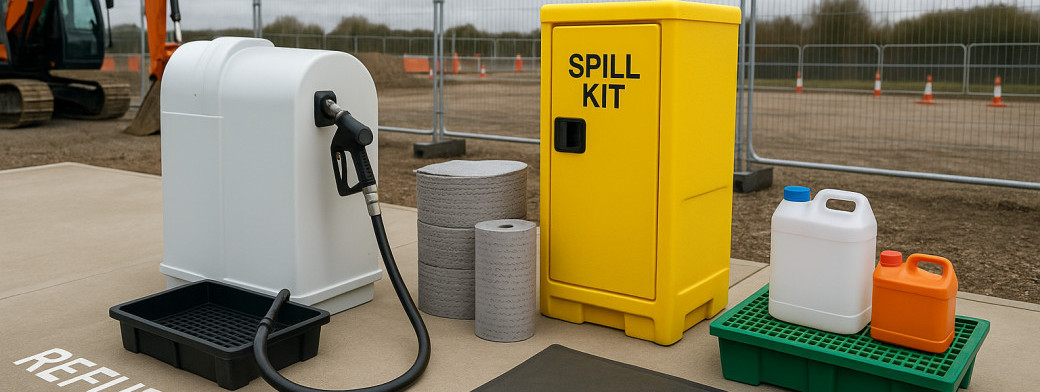
Construction & Civil Engineering Sites
Spill management on construction and civil engineering sites is rarely about one “big incident”. It’s usually a chain of small, predictable losses: a diesel splash during mobile refuelling, a weeping hydraulic fitting on a telehandler, a tote of admixture stored without secondary containment, or cement fines carried by rainfall into a gully.
This guide is written for UK site managers, Principal Contractors, SHEQ/HSE and procurement teams who need practical, repeatable controls. It focuses on real site scenarios: mobile plant refuelling, concrete washout and grout, weather-exposed spill kit stations, silt control vs chemical spills, and the documentation clients and Principal Contractors tend to expect.
Throughout, we reference widely used UK guidance such as the Environment Agency/NetRegs construction pollution prevention advice (NetRegs: Construction and pollution), CIRIA good practice for controlling water pollution from construction sites (CIRIA: Control of Water Pollution from Construction Sites (C648)), and HSE construction health & safety information (HSE: Construction).
Why construction sites are high-risk for spills
Construction sites are high-risk because conditions change daily. Multiple contractors work across shifting workfaces, plant routes evolve, temporary drainage is installed and removed, and materials are stored where there’s space rather than where it’s safest. Add weather exposure and the risk increases: wind-blown sheeting, flooded excavations, saturated ground and rapid runoff can carry contaminants far beyond the immediate work area.
From a legal and client assurance perspective, pollution prevention is not optional. Releases to controlled waters can trigger enforcement under the Water Resources Act 1991. Waste handling (including contaminated absorbents, used PPE and washout residues) must meet duty of care requirements in the Environmental Protection Act 1990. And where hazardous substances are present, assessments and controls link back to COSHH.
Good spill management supports programme certainty too: fewer stoppages, fewer clean-ups, fewer client escalations, and clearer evidence that you’ve applied “all reasonable steps” consistent with Environment Agency and CIRIA good practice.
Mobile plant refuelling: preventing diesel, hydraulic oil and AdBlue spills
Refuelling on site is a predictable spill point because it combines time pressure, uneven ground, weather, and variable competence. The typical spill sources include:
- Overfilling due to misjudged tank capacity or poor visibility.
- Damaged or incompatible nozzles/couplers and tired seals.
- Split hoses on bowsers or IBC dispensing set-ups.
- Drips from nozzle “afterflow” during disconnection.
- Hydraulic oil loss from quick couplers and hose failures during plant maintenance.
- AdBlue/DEF splashes and crystallised residues around fill points (slippery surfaces and housekeeping issues).
Set up a refuelling point (even if it’s “temporary”)
The Environment Agency’s construction pollution prevention guidance stresses the need to control fuels and oils to prevent polluting surface water drains and watercourses (NetRegs: Construction and pollution). In practical terms, a well-run refuelling point should aim to keep fuel handling away from drainage pathways and provide immediate containment capacity.
On many projects, a designated refuelling zone is achievable even with moving workfaces. Consider:
- Location: away from gullies, ditches, watercourses and surface water outfalls; avoid slopes where runoff will carry fuel.
- Ground conditions: level and stable enough to prevent bowser movement and reduce splash.
- Containment: use drip trays beneath dispensing points and plant fill points where practical; add spill containment and bunding where you’re storing fuels or servicing plant.
- Drain protection: keep drain protection equipment (covers, mats or blockers suited to your drainage type) close to the refuelling activity so the first responder can act fast.
If you are storing fuel in fixed tanks, make sure your arrangements align with applicable rules and good practice. For example, in England, certain oil storage installations are covered by the Control of Pollution (Oil Storage) (England) Regulations 2001. Even where regulations don’t strictly apply (for example, some mobile arrangements), clients often expect equivalent standards such as bunding, security, and robust inspection.
Absorbent selection for refuelling and plant leaks
Choose absorbents based on what you actually spill:
- Diesel, lubricants, hydraulic oils: use oil absorbents (oil-only) to target hydrocarbons and help avoid soaking up rainwater when working outdoors.
- Mixed fluids (coolant, water, oils) or general drips in workshops: use maintenance absorbents for broad compatibility.
- AdBlue and chemical additives: consider chemical absorbents where there’s a credible risk of acids/alkalis/chemicals (always confirm compatibility with your SDS and COSHH assessment).
For rapid response on moving workfaces, a construction site spill kit should be close to the activity, not stored in the main compound “for later”. For refuelling, many sites benefit from a smaller kit kept with the bowser/van plus a larger kit at the designated refuelling point.
Immediate response steps (keep it simple)
- Stop the source: isolate the nozzle, close valves, upright containers, or shut down plant.
- Protect drains: deploy drain protection first if there’s any pathway to surface water drains.
- Contain: use socks/booms to ring the spill and prevent migration.
- Absorb: use pads/rolls appropriate to the fluid (often oil-only for refuelling areas).
- Collect and segregate waste: bag used absorbents and label for appropriate disposal under your site waste arrangements (duty of care applies under the Environmental Protection Act 1990).
- Report: follow site and client reporting thresholds; record cause and corrective action.
Fire safety considerations: fuels are flammable, so keep ignition sources controlled and maintain good housekeeping around the refuelling point. Don’t overreach into specialist fire precautions, but do ensure your refuelling method aligns with site fire risk controls and that spill materials are stored safely and not left saturated in open bins.
Refuelling spill control checklist
- Designated refuelling area identified on the site environmental plan.
- Refuelling area positioned away from drains/watercourses and on stable ground.
- Drip trays available and used for routine refuelling and known weeping plant.
- Spill kits within quick reach of refuelling activities (not locked away).
- Oil-only absorbents stocked for diesel/hydraulic oil; compatible chemical absorbents available if required.
- Drain covers/mats checked for correct size and fit for local gullies/channels.
- Inspections: hoses, nozzles, couplers and seals checked and defects removed from service.
- Waste bags/labels available; used absorbents contained and removed promptly.
Concrete washout, grout and cement fines: different hazard, different controls
Concrete washout and grout residues are often treated like “just dirty water”, but they can be highly alkaline and damaging to aquatic life if released. CIRIA highlights that construction runoff, including cement and concrete-related pollutants, can severely impact watercourses if not controlled (CIRIA C648). The Environment Agency similarly stresses preventing contaminated runoff entering drains and water bodies (NetRegs).
The practical takeaway: don’t rely on “spill pads” alone for washout. You need containment, separation from drainage, and a defined disposal route.
Controls that work on busy sites
- Designated washout area: clearly signed and physically separated from drainage pathways (berms, barriers or temporary bunding).
- Containment: use lined washout skips/pits or purpose-built containment. Ensure capacity matches peak pours and plant turnover.
- Protect nearby drains: keep drain protection on hand for unexpected releases.
- Manage cement fines: prevent tracking by wheel wash management and housekeeping; stop dry cement powder reaching gullies.
- Storage of admixtures: store liquid admixtures and grout chemicals within bunded containment; use IBC bunds for IBCs commonly used for additives.
Neutralisation can be appropriate in some controlled systems, but it should be planned (not improvised) and aligned to your method statement, SDS and COSHH assessment. Poorly controlled neutralisation can create additional hazards. When in doubt, focus on isolation and containment first, then seek specialist waste/water treatment advice via your project environmental lead.
Concrete washout “Do / Don’t”
- Do set a single, well-marked washout point and brief all drivers and gangs.
- Do ensure washout containment cannot overflow in heavy rain (consider covers or raised freeboard).
- Do keep cement/grout materials away from surface water drains and watercourses as per Environment Agency good practice (NetRegs).
- Do keep a chemical-compatible spill response option available where admixtures or additives are used (check chemical absorbents for suitability).
- Don’t wash chutes/tools into gullies, highway drains, ditches or “temporary sumps” unless specifically designed and permitted for that purpose.
- Don’t rely on general absorbent pads for large volumes of wash water—containment is the primary control.
- Don’t move washout residues without an agreed waste route and appropriate containers (duty of care under the Environmental Protection Act 1990).
Weather-exposed spill kit stations: keeping response equipment usable
On UK sites, spill response equipment often fails for one simple reason: it’s left outside, gets waterlogged, and becomes unpleasant or ineffective to use. Rain-soaked absorbent pads add weight and reduce capacity; damaged packaging creates litter; and missing items mean delays when seconds matter.
A practical approach is to combine mobile kits (kept with plant/bowsers) with fixed points in the compound and at known high-risk locations. For fixed points, use robust, weather-resistant spill kit stations and cabinets so absorbents and drain covers stay dry and visible.
Positioning and signage
- Place stations where spills are likely: refuelling area, chemical storage, welfare/workshop areas, and near drainage interceptors.
- Keep access clear (no materials stacked in front).
- Use consistent signage so subcontractors can locate equipment quickly.
Stock levels, inspections and winter considerations
- Set a minimum stock: define what “ready” looks like (e.g., number of pads, socks, bags, ties, gloves).
- Inspect weekly and after heavy weather: replace waterlogged or degraded items immediately.
- Cold weather: ensure cabinet doors and latches work with gloves; consider positioning to reduce snow drift and standing water.
- Drain protection checks: verify your drain mats/covers still fit the actual gullies installed (temporary drainage layouts change).
Silt control vs chemical spills: don’t mix up the tools
Silt and sediment are among the most common pollution issues on civils projects, especially during earthworks and rainfall. But silt control measures are not a substitute for chemical spill response. CIRIA’s construction runoff guidance is clear that different pollutants require different controls (CIRIA C648).
Use silt control products (such as silt socks, inlet protection and barriers) to reduce sediment migration. Use absorbents, bunding and drain covers for oils and chemicals.
Quick decision table: first actions and product types
| Scenario | First actions | Recommended product types |
|---|---|---|
| Diesel splash during mobile refuelling near a gully | Stop source; protect the gully; contain; absorb | Drain protection, oil-only absorbents, socks/booms, drip trays |
| Hydraulic hose failure on excavator (oil to ground) | Shut down plant; contain spread; protect drains; collect waste | Oil absorbents, spill kit, temporary bunding |
| Concrete washout water escaping a designated area | Stop washout; block pathways; contain liquid; prevent drain entry | Physical barriers/berms, drain covers, compatible absorbents for small residues (as appropriate) |
| Runoff carrying sediment to a catchpit after rainfall | Slow the flow; intercept sediment; protect inlets; stabilise source | Silt control (socks, inlet protection, barriers) |
| Chemical additive/admixture leak from an IBC in the compound | Stop leak; isolate area; contain with secondary containment; absorb/collect | IBC bund, chemical absorbents, overpack drums |
Meeting Client and Principal Contractor requirements
Beyond legislation, most construction spill controls are driven by client/Principal Contractor standards and assurance processes. Common expectations include:
- A site-specific spill response plan integrated into the Construction Phase Plan and environmental management plan (aligned with HSE construction expectations: HSE Construction).
- A clear COSHH interface: SDS available, spill controls matched to substances, and compatible PPE and absorbents identified (see COSHH).
- Evidence of pollution prevention measures consistent with Environment Agency/NetRegs good practice (NetRegs).
- Inspection records: bunds, storage, spill kits, drip trays, and drainage protection.
- Incident reporting arrangements, including near-miss reporting and corrective actions.
- Waste handling: segregating contaminated materials and documenting transfers (duty of care under the Environmental Protection Act 1990).
- Subcontractor alignment: everyone knows where kits are and what to do first.
Template-style compliance checklist (adapt to your site)
- Spill risks reviewed by area (refuelling, workshops, compounds, washout, drainage interfaces).
- Spill response plan briefed at induction and reinforced via toolbox talks.
- Spill kit locations shown on site plans; signage installed.
- Drain protection identified for each drainage type on site.
- Secondary containment in place for fuels/chemicals (bunds, IBC bunds).
- Routine inspections logged; defects closed out with dates and owners.
- Waste route confirmed for used absorbents and contaminated materials; storage area identified.
- Spill drills or short practical “show me” checks scheduled and recorded.
Product selection guide for construction sites
Selection works best when you size by risk (credible spill volume) and location (distance to drains/watercourses, access time, exposure to weather). The aim is to support response, reduce risk, and meet typical client standards—without overbuying.
Absorbents
- Refuelling and plant leaks: oil absorbents (pads, rolls, socks) to target hydrocarbons and help avoid rainwater uptake outdoors.
- Workshops and mixed drips: maintenance absorbents for oil-and-water mixtures and general housekeeping.
- Admixtures, acids/alkalis, unknown chemicals: chemical absorbents selected with COSHH/SDS compatibility in mind.
Spill kits (by use-case)
- Mobile/vehicle kits: for site vehicles, bowsers and maintenance vans—rapid first response where the spill happens.
- General site kits: for compounds, workshops and refuelling points—often best sourced from the main spill kits range and matched to anticipated volumes.
- Chemical spill kits: where chemicals/admixtures are stored or used (ensure the kit location mirrors the storage location).
- Protected storage: use spill kit stations/cabinets for exposed areas to keep contents dry and serviceable.
Containment and storage protection
- Secondary containment: spill containment/bunding supports controlled storage and helps prevent small leaks becoming incidents.
- IBC storage: IBC bunds for additives, detergents and other liquids delivered in IBCs.
- Small leaks and servicing: drip trays under dispensing points and known drippers (generators, compressors, static plant).
- Drain interface protection: drain protection products near high-risk activities and at key outfalls/interceptors (as identified by your site drainage plan).
- Damaged containers and recovery: overpack drums to safely place leaking drums/containers pending disposal or specialist handling.
Implementation: a simple 30-day rollout plan
If you’re tightening up spill management mid-project (or standardising across multiple sites), a short rollout plan helps procurement and operations land changes quickly.
Week 1: assess and map
- Walk the site with the drainage plan: identify gullies, channels, outfalls, ditches and overland flow routes.
- Mark high-risk activities: refuelling, chemical storage, washout, workshops, generator areas.
- Confirm what substances are present and where (SDS/COSHH interface).
Week 2: install controls at the hotspots
- Set up/refine the refuelling point: drip trays, bunding where needed, drain protection available.
- Improve storage: add IBC bunds and bunded areas for oils/chemicals.
- Confirm washout arrangements and signage; ensure capacity and rain resilience.
Week 3: deploy kits and standardise
- Place appropriately sized spill kits at each hotspot and in mobile locations.
- Install spill kit stations/cabinets for exposed areas.
- Standardise contents across the project so crews know what they’ll find.
Week 4: train, test, record, improve
- Run short “show me” drills at refuelling and near drainage points: stop source, protect drain, contain, absorb, bag waste.
- Introduce a simple weekly inspection sheet for spill stations, bunds and washout.
- Review near misses and adjust kit placement/contents accordingly.
FAQs
What’s the minimum a construction site spill kit should include?
Typically: absorbent pads, socks/booms for containment, waste bags and ties, suitable gloves, and simple instructions. If there’s any chance of reaching drains, include or co-locate drain protection. Match the absorbent type (oil-only, maintenance, chemical) to the substances on your site.
How do I choose between oil-only and maintenance absorbents?
Use oil-only where hydrocarbons are the main risk (refuelling, hydraulic leaks), especially outdoors. Use maintenance absorbents where mixed fluids are likely (workshops, general plant servicing) and you need absorption of both oils and water-based liquids.
Do we need a separate chemical spill kit for admixtures and grout chemicals?
If you store or use liquids that your COSHH assessment identifies as hazardous (e.g., corrosive/irritant), a chemical-compatible response option is sensible. Consider chemical absorbents and a designated kit near the storage/use point.
How often should spill kit stations be inspected on a live civils site?
Weekly is a common baseline, plus after heavy rain/wind and after any spill response use. The key is consistency and recording: clients and Principal Contractors often want evidence of checks.
Can we use silt socks as booms for oil spills?
They’re designed for sediment control, not chemical compatibility or oil absorption. For hydrocarbons, use spill booms/socks and oil absorbents, and protect drains early.
What should we do with used absorbents and contaminated PPE?
Contain and label the waste, store it securely, and dispose of it via your site’s waste arrangements. Your duty of care responsibilities come from the Environmental Protection Act 1990, and classification/handling should align with the nature of the contaminant and your waste contractor’s requirements.
What documentation do clients usually expect?
A spill response plan, COSHH/SDS access, inspection records for spill stations and containment, training/toolbox talk records, and incident/near-miss reports with corrective actions. CIRIA and Environment Agency good practice references can strengthen your method statements (see CIRIA C648 and NetRegs).
Conclusion & CTA
On construction and civil engineering projects, strong spill management is built from simple, repeatable actions: map the risks, control refuelling, separate washout, protect drains, and keep equipment usable in all weathers. Aligning your controls with recognised UK guidance from the Environment Agency/NetRegs, CIRIA and HSE helps you meet client expectations and reduce risk across changing workfaces.
If you’re reviewing your current set-up, Serpro can help you choose practical solutions for a construction site spill kit, refuelling spill control, concrete washout interfaces, drain protection and storage containment. Explore spill kits, spill kit stations and cabinets, spill containment/bunding and drain protection to match your site risks.