
Effective Spill Management for Rail Depots, Sidings & Trackside Operations
Context: why spill management is different on the railway
Rail depots, sidings and trackside work sites bring together fuels, lubricants, coolants, cleaning chemicals, battery electrolytes, paints, herbicides and waste oils in environments that are hard to control: open drainage, uneven ballast, confined access, moving plant, live lines, and 24/7 operations. A small leak can quickly become a reportable pollution incident if it reaches a surface water drain, ditch, culvert or watercourse. Network Rail’s environmental commitments emphasise reducing pollution risks and improving environmental performance across the network, which places practical expectations on contractors and operators working trackside and in depot settings (Network Rail – Sustainability).
Spill management in rail settings therefore needs to be: (1) compliant with health, safety and environmental duties, (2) designed for the specific hazards of each location (depot, siding, yard, trackside), and (3) demonstrably implemented through training, equipment, inspections and records. The aim is not only to “clean up”, but to prevent releases, contain them quickly, protect people, and evidence due diligence.
Regulatory: UK compliance touchpoints rail operators should evidence
Spill management sits at the intersection of health & safety and environmental protection. The Office of Rail & Road (ORR) sets expectations for how rail operators manage health and safety risks, including safe systems of work, competence, and control of risks arising from operations in depots and on the network (ORR – Health & Safety Guidance). From a pollution perspective, the Environment Agency’s guidance on pollution prevention (via NetRegs) provides practical measures for preventing and responding to spills of fuels and chemicals, including good housekeeping, bunding/containment, drain protection and incident response planning (Environment Agency/NetRegs – Guidance for Pollution Prevention).
To be audit-ready, rail operators should be able to show:
- Risk assessment and planning: spill scenarios identified by area and task, with controls selected and reviewed (aligned to ORR expectations for managing operational risks: ORR).
- Pollution prevention controls: measures such as secondary containment, protected drainage, and good storage/handling practices (as set out in pollution prevention guidance: NetRegs).
- Emergency preparedness: clear response procedures, trained staff, and suitable spill equipment positioned where spills could occur (a core theme of pollution prevention guidance: NetRegs).
- Environmental stewardship trackside: alignment with infrastructure owners’ expectations to minimise pollution incidents and impacts (see Network Rail’s sustainability focus: Network Rail).
Hazard mapping: build a spill risk picture by location and activity
A robust spill plan starts with hazard mapping: identify what can spill, where it could travel, and what it could harm. Pollution prevention guidance highlights the importance of understanding pathways to drains and watercourses and taking steps to prevent contamination (NetRegs).
1) Depots and maintenance facilities
- Sources: diesel, petrol (if present), hydraulic oils, gear oils, greases, coolants, detergents, solvents, battery acids/alkalis.
- Common spill points: refuelling bays, IBC and drum storage, parts washers, waste oil tanks, interceptors, wash plants, bunded areas, loading/unloading points.
- Pathways: yard drains, wash-down drains, interceptor bypasses, door thresholds, service pits.
- Receptors: surface water drains/outfalls, groundwater, nearby watercourses, staff and contractors.
2) Sidings, yards and stabling points
- Sources: fuel and oil leaks from rolling stock, lubricants from maintenance activities, small chemical containers used for cleaning.
- Pathways: ballast migration, drainage ditches, culverts, soakaways, trackside drains.
- Receptors: watercourses, vegetation, adjacent land, public areas.
3) Trackside worksites (possessions, renewals, civils)
- Sources: plant hydraulics, fuel bowsers, generators, oils and greases, concrete additives, herbicides (where used).
- Pathways: overland flow to ditches, direct entry to culverts, migration along ballast, wind spread of light absorbents if not secured.
- Receptors: watercourses, sensitive habitats, third-party land, staff.
Practical mapping tip: add “drain direction arrows” and outfall locations to depot plans and worksite packs. Pollution prevention guidance places strong emphasis on protecting drainage and preventing contaminants entering surface water systems (NetRegs).
Controls: prevention first, then containment, then clean-up
Spill management should follow a hierarchy: prevent leaks, contain what does leak, then recover/clean. Pollution prevention guidance promotes good storage, handling and containment to reduce the likelihood and impact of spills (NetRegs).
Engineering and physical controls
- Secondary containment: bunded storage for drums/IBCs; drip trays under static leak points; sump management.
- Drain protection: keep drain covers/mats available near high-risk activities; know which drains go to surface water vs foul.
- Dedicated refuelling areas: level surfaces, good lighting, clear signage, spill equipment within immediate reach.
- Plant and hose management: routine inspection of bowsers, hoses and couplings; use auto shut-off nozzles where suitable.
Operational and administrative controls
- Housekeeping: keep absorbents accessible; remove oily rags and waste promptly; maintain clear access to drains and isolation points.
- Task planning: include spill controls in method statements (e.g., “drain protection before decanting”). ORR guidance underscores the need for safe systems of work and competent planning in operational environments (ORR).
- Environmental expectations trackside: ensure contractors understand site rules and pollution prevention expectations aligned with Network Rail’s sustainability direction (Network Rail).
Kit strategy: selecting and positioning spill equipment for rail realities
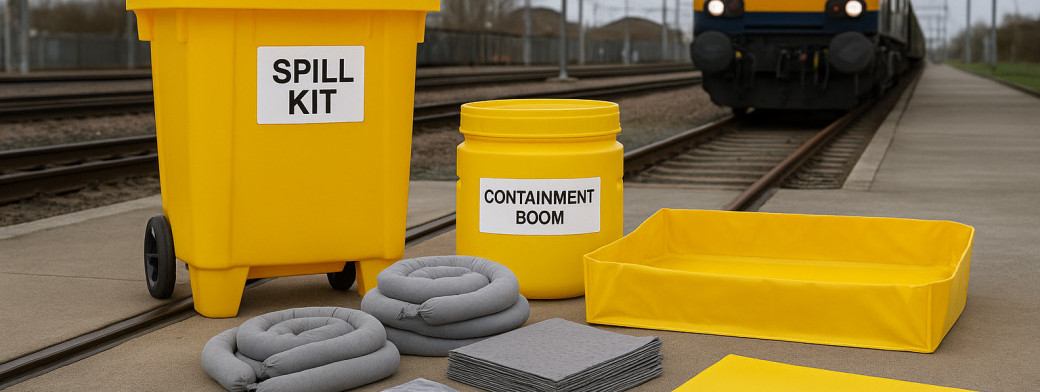
Spill kits only work if they are correctly matched to the hazard, placed where spills occur, and replenished. For most rail operators, a layered approach is best: small “grab kits” near point-of-use, plus larger kits for refuelling bays and mobile response.
Absorbents: choose by liquid type and surface
Absorbents should be selected based on what you expect to spill (oils, fuels, coolants, chemicals) and where (concrete, tarmac, ballast, near water). To build a consistent standard across sites, define what “good” looks like in procurement specifications and issue the same core absorbent formats (pads, socks, pillows, granules) across depots and contractors. For options and formats, see Serpro absorbents.
- Oil-only absorbents: for hydrocarbons where water may be present (e.g., rain-soaked yards). Use socks/booms to ring leaks and protect drains.
- General purpose absorbents: for non-aggressive liquids such as coolants and water-based fluids (where compatible with your SDS).
- Chemical absorbents: for acids/alkalis/solvents; ensure compatibility with the substances on site and your COSHH controls.
Note on fibres: in windy trackside locations, loose absorbent fibres can migrate. Prefer bonded pads/rolls and secured socks, and plan how you will retrieve materials from ballast after use.
Spill kits: size and placement rules of thumb
Standardise kit types (e.g., 20L/50L/120L equivalents) and place them by risk, not by convenience. A practical approach is to keep kits within a short walk of refuelling, chemical storage and maintenance bays, and to provide mobile kits on road-rail vehicles or support vans for possessions. For kit types and configurations, see Serpro spill kits.
- Point-of-use mini kits: near battery charging, small chemical cupboards, cleaning stations.
- Refuelling bay kits: larger capacity, drain protection, disposal bags and ties, PPE guidance card.
- Trackside mobile kits: oil-focused plus drain/ditch protection elements; include a simple laminated response flowchart.
Containment products: stop migration, protect drains, control run-off
Containment is often the difference between a manageable clean-up and a major pollution incident. Pollution prevention guidance stresses preventing spills entering drains and watercourses (NetRegs). Consider adding dedicated containment products such as drain covers, drip trays and temporary bunding where appropriate; see Serpro containment products.
Procedures & training: make spill response repeatable and auditable
Procedures should be short, site-specific, and rehearsed. ORR health and safety guidance expects dutyholders to manage risks through competent people and effective arrangements (ORR). Pollution prevention guidance reinforces the need for planning and prompt action to reduce environmental harm (NetRegs).
A simple spill response sequence (adapt to your site)
- Stop: if safe, shut valves, right containers, isolate pumps, stop refuelling.
- Warn: alert supervisor/control; keep people away; consider ignition sources for fuels.
- Protect drains: deploy drain covers or socks first where there is a pathway to drainage (priority emphasised in pollution prevention guidance: NetRegs).
- Contain: ring with socks/booms; use temporary bunding if relevant.
- Recover/absorb: apply pads/rolls/pillows; avoid spreading contamination.
- Dispose: bag, label and store waste safely pending collection.
- Report & record: capture time, location, estimated volume, substance, actions taken, waste route, photos.
Training that stands up in audits
- Induction: site drainage awareness (what drains to surface water), kit locations, who to call.
- Role-based competence: refuelling staff, fitters, plant operators, cleaners, contractors.
- Toolbox talks: seasonal focus (e.g., winter rain increases pathway risk), trackside constraints.
- Exercises: short, realistic drills at refuelling bays and trackside muster points; record attendance and lessons learned (supports ORR-style assurance of arrangements: ORR).
Waste & evidence: disposal, documentation and proving due diligence
Spill waste is often hazardous (oily absorbents, contaminated PPE, chemical residues). Pollution prevention guidance highlights good practice in managing pollution incidents and preventing secondary contamination (NetRegs). To be audit-ready, build a simple evidence pack for each incident and a routine record for inspections.
What to record for every spill (even minor)
- Date/time, precise location (depot bay, siding name, mileage/chainage if trackside).
- Substance and estimated quantity; reference SDS where relevant.
- Weather conditions (rain/wind can change pathways).
- Immediate actions: drain protection deployed, containment used, clean-up method.
- Waste generated: number of bags, type of absorbents, temporary storage location.
- Photos before/during/after, including protected drains and waste bags.
- Root cause and corrective actions (equipment repair, process change, retraining).
Waste handling essentials
- Segregate oil-only vs chemical-contaminated waste where possible.
- Label bags/containers clearly (site, date, substance).
- Store securely to prevent re-release (covered, bunded where appropriate).
- Use approved contractors and retain transfer/consignment documentation as applicable.
Checklists: ready-to-use controls for depots and trackside
Prevention checklist (weekly/monthly)
- Are fuel/chemical storage areas bunded and tidy, with no standing liquids?
- Are hoses, couplings and bowsers inspected and defects recorded/rectified?
- Are drain maps up to date and visible, with surface water drains identified?
- Are interceptors and drainage controls maintained and not bypassed?
- Are high-risk tasks planned with pollution controls (per pollution prevention guidance: NetRegs)?
Spill kit readiness checklist (weekly)
- Kits are present at defined locations and unobstructed.
- Contents complete: pads/rolls, socks/booms, disposal bags/ties, gloves, instructions.
- Drain covers/containment items present where drains are nearby (pollution prevention emphasis: NetRegs).
- Used items replenished; expiry/condition checked.
- QR code or log sheet updated (date, inspector, actions).
Immediate response checklist (first 10 minutes)
- Stop source if safe; isolate ignition sources for fuels.
- Protect drains/ditches first.
- Contain spread; keep spill out of ballast margins where possible.
- Use correct absorbent type; avoid incompatible materials for chemicals.
- Notify internal contacts; escalate if there is any risk to watercourse (aligned to pollution prevention guidance principles: NetRegs).
Case study (example): diesel spill at a depot refuelling point
Scenario: During evening refuelling, a coupling fails and diesel releases onto concrete near a surface water drain. Rain is forecast within the hour.
Response:
- Stop and make safe: refuelling stops; the line is depressurised and the coupling isolated.
- Drain protection first: a drain cover is placed immediately, consistent with pollution prevention guidance priorities to prevent entry to drainage (NetRegs).
- Containment: absorbent socks are laid to ring the spill and create a barrier at the yard fall line.
- Recovery: oil-only pads are applied from the outside inward to minimise spread; saturated materials are bagged.
- Inspection: the area is checked for sheen and slip risk; the drain cover remains until the surface is dry and clean.
- Evidence: photos taken of the protected drain, the contained spill and the bagged waste; an incident record includes estimated volume and corrective actions.
Corrective actions:
- Replace coupling and introduce a pre-use coupling check.
- Move a larger spill kit closer to the refuelling point and add a second drain cover.
- Run a short drill for night shift staff, supporting consistent competence and arrangements expected in ORR-style safety management (ORR).
FAQs
What should be the first priority in a spill near drains or ditches?
Protecting drainage and preventing the spill reaching surface water is typically the fastest way to reduce environmental harm. Pollution prevention guidance repeatedly stresses preventing contaminants entering drains and watercourses (NetRegs).
How do we decide between oil-only and chemical absorbents?
Base it on your site inventory and SDS: hydrocarbons (diesel, oils) suit oil-only products, especially outdoors where rainwater may be present; aggressive chemicals require compatible chemical absorbents. Standardising absorbent formats across sites helps responders act quickly; see absorbents for typical product categories.
What does “audit-ready” look like for spill management?
Evidence of planning (risk assessments and site drain maps), readiness (inspected and replenished kits), competence (training records and drills), and learning (incident logs with corrective actions). ORR guidance sets expectations around effective arrangements and management of health and safety risks (ORR), while pollution prevention guidance supports practical measures and response planning (NetRegs).
How should we equip trackside teams differently from depot teams?
Trackside teams need mobile, weather-robust kits with strong containment focus (socks/booms, drain/ditch protection) and instructions that work in low light. Depot teams often need higher capacity at fixed points (refuelling, chemical stores) and more variety (oil-only, general purpose and chemical kits). A structured approach to spill kits and containment products helps align equipment to risks.
What about absorbent fibres getting into ballast?
Plan to minimise loose fibres by using bonded pads/rolls and secured socks, and include retrieval steps in the method statement. The key is to contain quickly and recover thoroughly so contaminated materials are not left to migrate with rain or vibration.
Conclusion: a practical, compliant spill management baseline
Effective spill management for rail depots, sidings and trackside operations is built on three pillars: (1) prevention and engineered controls (containment, drain protection, good storage), (2) the right equipment in the right places (absorbents, spill kits and containment products), and (3) repeatable procedures backed by training and evidence. Align your arrangements with ORR expectations for managing operational risks (ORR), apply practical pollution prevention measures from the Environment Agency/NetRegs guidance (NetRegs), and ensure trackside environmental responsibilities support Network Rail’s sustainability direction (Network Rail). When spills do happen, fast drain protection, effective containment and thorough documentation will reduce harm and strengthen compliance.