
Published: 20 March 2026
Last updated: 17 March 2026
What are the Key Containment Measures for Laundry Chemical Dosing Rooms?
Containment measures in laundry chemical dosing rooms are the physical controls, operating procedures and spill-response provisions used to prevent, capture and safely manage leaks, splashes and failures involving concentrated laundry chemicals. In this setting, the main risks usually come from alkalis, acids and dosing line failures, so effective containment typically includes bunded storage, drip trays, corrosion-resistant flooring, leak-proof transfer points, clear segregation of incompatible products, and suitable absorbents or neutralising materials. In the UK, these controls should support compliance with COSHH requirements and relevant guidance on detergents and dosing chemicals.
Laundry dosing rooms commonly handle strong alkalis for soil removal and wash performance, alongside acids used for neutralising, descaling or pH correction. Because these products are often stored and dispensed in concentrated form, even a small escape can damage surfaces, attack pipework, create slip hazards and expose staff to burns or harmful vapours. Good containment therefore means planning for both routine drips and sudden line ruptures, while ensuring that storage, handling and clean-up arrangements align with UK health, safety and environmental duties.
Core containment controls for alkalis and acids
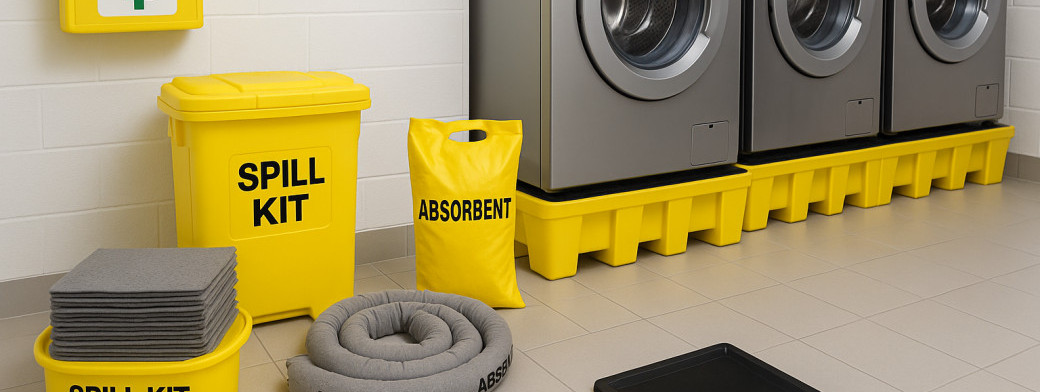
Alkalis and acids should be stored in clearly labelled, segregated areas with secondary containment sized for credible spill volumes. Bunds, sumps and chemical-resistant drip trays help prevent spread across the room, while impermeable floors and raised thresholds stop contaminated liquids reaching drains or adjacent work areas. Transfer and dosing points should be positioned over contained surfaces, with eyewash and emergency equipment located nearby. Businesses reviewing these risks should also consider wider chemical safety controls and how dosing room design fits into broader laundry solutions.
Managing dosing line failures
Dosing line failures can include split tubes, loose connections, perished seals, blocked injectors or pump faults that cause overfeed, underfeed or uncontrolled discharge. Key measures include routine inspection, compatible pipe materials, secure fixings, isolation valves, leak detection, preventive maintenance and documented emergency procedures. Any contaminated absorbents, residues or damaged components must then be handled and disposed of in line with UK hazardous waste duties.
Why is Containment Critical in Laundry Chemical Dosing Rooms?
Containment is critical in laundry chemical dosing rooms because even small leaks from alkalis, acids or failed dosing lines can quickly create serious safety, environmental and compliance risks. These areas often handle concentrated detergents, destainers, sanitisers and pH-correction chemicals, so an uncontrolled spill can spread across floors, attack surfaces, mix with incompatible products and expose staff to splashes, vapours or slip hazards. Effective containment helps isolate spills at source, supports safer clean-up and reduces the chance of a minor dosing fault becoming a wider incident.
In practical terms, good containment protects people, the workplace and the business. Bunded storage, drip trays, chemical-resistant flooring, leak capture beneath pumps and lines, and clear spill response procedures all help prevent chemicals escaping into drains or circulation areas. This aligns with UK duties under COSHH guidance from HSE and the wider regulatory expectations for detergents and laundering chemicals set out by HSE.
Risks Associated with Chemical Spills
Chemical spills in dosing rooms can result from split containers, overfilling, cracked pipework, loose fittings or dosing line failures. Caustic alkalis may cause severe burns, while acidic products can damage skin, eyes, equipment and nearby surfaces. If different chemicals mix, the reaction may generate heat, fumes or violent splashing. Spills also create immediate slip risks, especially where liquids track into walkways or service corridors.
Impact on Health and the Environment
Without proper containment, staff may suffer skin contact, eye injuries or inhalation exposure during routine work or emergency clean-up. Environmental harm is also a major concern: contaminated wash-down water, absorbents and residues must be handled correctly, and businesses have a duty of care when disposing of hazardous waste. GOV.UK provides guidance on how to dispose of hazardous waste lawfully and safely.
Legal and Compliance Consequences
Failure to contain spills properly can lead to breaches of health, safety and environmental law, enforcement action, clean-up costs and operational disruption. Employers should support containment with suitable procedures, staff training and a documented risk assessment, alongside broader health and safety controls. In short, containment is not just good practice; it is a fundamental part of safe and compliant chemical management in laundry environments.
What are the Best Practices for Managing Alkalis and Acids?
The best practices for managing alkalis and acids in laundry chemical dosing rooms are to segregate incompatible chemicals, store them in secure bunded areas, equip staff with suitable PPE, and maintain clear emergency procedures for leaks, splashes, and dosing line failures. In UK laundry settings, these controls help reduce the risk of burns, toxic reactions, slip hazards, and environmental contamination while supporting compliance with COSHH guidance from HSE.
Because laundry dosing rooms often handle concentrated detergents, alkalis, acids, and oxidising products, safe management depends on both prevention and response. Storage, labelling, staff training, and spill readiness should all be reviewed together so that a minor container leak or ruptured dosing tube does not escalate into a serious incident.
Storage guidelines for alkalis and acids
Alkalis and acids should be stored separately to prevent dangerous reactions if containers fail or lines are disconnected. Use corrosion-resistant shelves or cabinets, keep products in clearly labelled original containers where possible, and provide secondary containment such as drip trays or bunds sized for the likely volume of leakage. Dosing pumps, connections, and transfer lines should be inspected routinely, with damaged hoses or brittle fittings replaced before failure occurs. Good ventilation, restricted access, and up-to-date chemical inventories also support safe storage and handling. HSE’s guidance on detergents in Great Britain provides useful regulatory context for laundering operations.
PPE recommendations
Anyone handling concentrated laundry chemicals should wear task-appropriate chemical-resistant gloves, eye protection, and protective clothing, with face protection used where splashing is possible. Footwear should be slip-resistant and suitable for wet processing areas. Employers should select and maintain PPE based on the specific products in use, exposure routes, and manufacturer safety data sheets.
Emergency response procedures
Emergency procedures should cover spills from containers, dosing pumps, and dosing lines. Staff should know how to isolate the chemical supply, stop the leak if safe to do so, cordon off the area, and use suitable absorbents or containment materials for corrosive liquids. Eyewash and drench facilities should be accessible, and all incidents should be reported and reviewed. For broader planning, see emergency response guidance. Contaminated absorbents, residues, and damaged containers must be handled in line with UK hazardous waste disposal requirements.
How to Address Dosing Line Failures Effectively?
Dosing line failures should be addressed by identifying the cause quickly, isolating the affected chemical feed, containing any leak at source, and repairing or replacing damaged components before dosing resumes. In laundry chemical dosing rooms, even a small failure can release concentrated alkalis, acids, oxidising agents or detergents, creating slip, splash, fume and corrosion risks. A clear response plan, supported by suitable containment and routine inspection, helps minimise harm to staff, equipment and drains while supporting compliance with COSHH requirements.
The most effective approach combines early leak detection with preventative maintenance. This means understanding where failures typically occur, checking lines and fittings regularly, and ensuring secondary containment is in place around pumps, drums and transfer points. Facilities that review their chemical dosing arrangements and schedule planned maintenance are better placed to prevent minor defects from becoming hazardous releases.
Common causes of dosing line failures
Most dosing line failures result from wear, chemical incompatibility or poor installation. Common issues include perished tubing, cracked pump heads, loose unions, damaged non-return valves, blocked injection points, over-pressurisation and vibration loosening fittings over time. Lines may also degrade if the tube material is not suitable for the chemical being dosed, particularly with aggressive alkalis or acidic products. Kinking, abrasion and accidental impact during drum changes can also weaken lines and connections.
Detection methods for leaks
Leaks should be identified as early as possible through both visual checks and engineered controls. Operators should look for drips, staining, crystallisation, corrosion, odours, wet floors and unexplained chemical loss from containers. Low-level containment trays, drip trays and bunded areas make small releases easier to spot before they spread. Where risk is higher, consider leak detection sensors, level monitoring, flow alarms or automatic shut-off systems to flag abnormal dosing behaviour. Any contaminated absorbents or residues must be handled in line with UK hazardous waste disposal requirements.
Preventative maintenance practices
Preventative maintenance should include routine inspection of tubing, joints, valves, pumps and calibration points, with planned replacement of consumable parts before end of life. Keep chemical compatibility records, tighten fittings to specification, secure lines against movement and protect them from heat or mechanical damage. Staff should also be trained to isolate feeds safely, report defects promptly and verify that containment materials are suitable for the chemicals present. Regular review against HSE guidance on detergents and chemical management helps maintain safe operation.
What are the Regulatory Requirements for Chemical Containment?
In UK laundry chemical dosing rooms, the main regulatory framework for chemical containment is the Control of Substances Hazardous to Health (COSHH). COSHH requires employers to assess the risks created by hazardous substances such as alkalis, acids, detergents and dosing chemicals, and to put suitable control measures in place to prevent exposure, leaks and uncontrolled spills. In practice, this means containment arrangements must be appropriate to the chemicals used, the likelihood of dosing line failures, and the potential for harm to workers, drains and surrounding areas.
For laundry settings, compliance is not limited to reacting to spills after they happen. Employers are expected to prevent releases where reasonably practicable through safe storage, compatible bunding, secure dosing equipment, clear segregation of incompatible chemicals, and suitable emergency response arrangements. HSE guidance on COSHH and detergents supports a risk-based approach in which containment, inspection, maintenance and staff competence all work together.
COSHH and containment expectations
Under COSHH, employers must identify hazardous substances, assess how workers may be exposed, and implement controls that reduce risk to an acceptable level. In a dosing room, this commonly includes secondary containment for chemical containers, measures to manage hose or dosing line failures, and procedures for dealing with contaminated absorbents and residues. Where waste is produced after a spill, disposal must follow UK hazardous waste rules and duty-of-care requirements, as outlined by GOV.UK guidance on hazardous waste.
Employer responsibilities, records and training
Employers are responsible for maintaining safe systems of work, keeping containment equipment fit for purpose, and reviewing risk assessments when chemicals, layouts or processes change. They should also document COSHH assessments, inspection and maintenance records, spill response procedures, and waste handling arrangements. For a broader view of legal duties and practical controls, see regulatory compliance guidance.
Training is also a core requirement. Staff should understand the hazards of the products they handle, the action to take in the event of a leak or spill, and the correct use of PPE and containment materials. Refresher instruction is important where concentrated chemicals or automated dosing systems are used; see chemical safety training for related guidance.
What Should be Included in a Chemical Spill Response Plan?
A chemical spill response plan for a laundry chemical dosing room should set out exactly what to do when acids, alkalis, detergents or dosing line leaks occur. At minimum, it should define how to raise the alarm, isolate the source, protect people, contain the spill, clean up safely, and dispose of contaminated materials in line with HSE COSHH guidance. In laundry environments, the plan should be specific to concentrated chemicals, transfer points, pumps, drums, IBCs and dosing lines, because these are the most common sources of sudden releases.
An effective plan is practical, site-specific and easy for staff to follow under pressure. It should identify the likely spill scenarios in the room, the hazards of each product, the location of spill kits and PPE, and the steps needed to prevent chemicals reaching drains or mixing incompatibly. It should also link to wider emergency arrangements, maintenance reporting and hazardous waste disposal requirements under GOV.UK hazardous waste guidance.
Key elements of the spill response plan
The plan should include a clear spill classification system, such as minor drips, dosing line failures, container breaches and major bund overtopping events. For each scenario, specify immediate actions: stop dosing equipment if safe, isolate pumps, restrict access, ventilate if required, and use the correct absorbents or neutralising materials. Include a site layout showing shut-off points, eyewash stations, drains, bunded areas and stocked spill response equipment. Product safety data sheets, incompatibility information and escalation triggers should be available at the point of use. For broader guidance on planning and equipment selection, see spill response.
Roles and responsibilities during a spill
The plan should name who does what. Operators may raise the alarm and isolate the area; trained responders may assess hazards, contain the release and manage clean-up; supervisors may decide when production stops and when external support is needed. It should also define who records the incident, arranges replenishment of used materials and reviews root causes such as split tubing, failed non-return valves or poor drum connections.
Training and drills for staff
Training should cover chemical hazards, PPE selection, spill kit use, drain protection, first aid measures and reporting lines. Regular drills help staff practise realistic incidents, including acid or alkali splashes and dosing line failures, so responses become faster and safer. Refresher sessions should follow process changes, new chemicals or incidents. Structured training supports competence and helps ensure the written plan works in practice.