
Spill Control for Marine Facilities: Managing Oil, Fuel & Marine-Related Liquids

Context: Why Spill Control Matters in Marine Operations
Managing spills effectively is crucial in marine operations due to the potential for significant environmental damage and regulatory repercussions. Oil and fuel bunkering, hydraulic fluids, bilge and cargo leaks can all lead to contamination of protected waters, impacting marine ecosystems and the facility's reputation.
According to the Maritime & Coastguard Agency, a robust oil spill contingency plan is essential for any marine operation. Failure to manage spills can result in severe fines, legal action, and loss of business, making proactive spill management not just a regulatory requirement but a commercial imperative.
Regulatory Backdrop
Marine facilities in the UK must comply with regulations set forth by various bodies, including the Health & Safety Executive (HSE), the Environment Agency, and the Maritime & Coastguard Agency (MCA). Furthermore, the International Maritime Organization (IMO) establishes obligations under the OPRC Convention for oil pollution prevention.
Each of these regulatory frameworks emphasises the need for effective spill response strategies that protect the environment, maintain compliance, and safeguard public health.
Hazard Mapping
Identifying potential spill sources is essential in developing an effective spill management strategy. Typical fluids and potential spill sources in marine settings include:
- Bunker fuel
- Diesel
- Lubricants
- Hydraulic oils
- Bilge water/sludge
- Greases
- Antifreezes
- Cleaning solvents
- Cargo-tank wash vapours
Common zones of concern include:
- Vessel bunkering terminals
- Fuel barges
- Ship-to-shore transfers
- Maintenance docks
- Slipways
- Marina service berths
- Wash-down zones
- Bilge-pumping stations
Controls
Implementing effective controls is vital for spill prevention and response:
- Use oil-only absorbents that repel water, ideal for hydrocarbons on water surfaces.
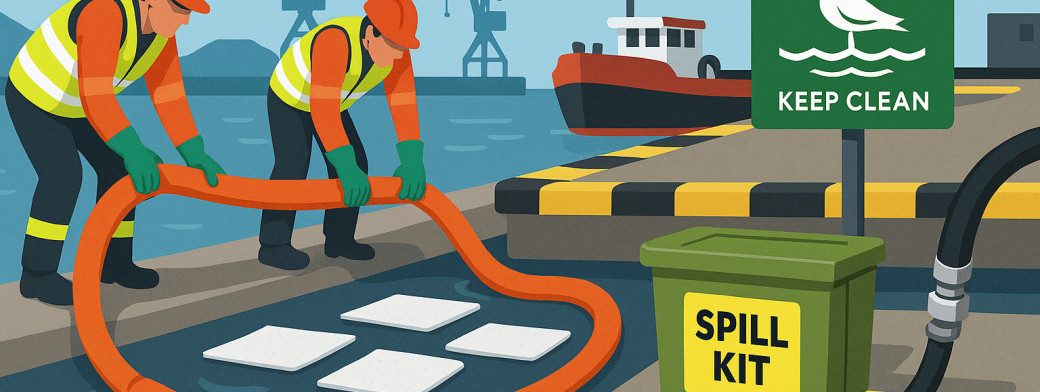
- Deploy floating booms, skimmers, and containment pads for any spill near open water.
- Ensure bunded storage pallets, drip trays under bunkering hoses, sealed transfer lines, and drip-loose hoses are in place.
- Protect harbour drains, sand-silt traps, and storm outfalls from contamination by aligning with Environment Agency guidance.
- Organise specific kits for marine use: “Oil & Fuel Marine Spill Kits” with containment dams, boom socks, sorbent cushions, gloves, and waste bags.
- Include anti-static and weather-rated equipment for deck transfers and outdoor use.
Kit Strategy
Correct kit sizing, placement, and restocking strategies are essential in marine settings. Ensure spill kits are situated near high-risk areas such as berths, fuel docks, service boat sheds, and maintenance hoists. Understand the differences between oil-only kits and universal kits:
- Oil-only kits are specifically designed for petroleum-based spills.
- Universal kits are suitable for managing various liquids, including bilge water or mixed liquids.
Regular inspection is crucial; conduct weekly checks of berthing-zone kits and monthly drills with harbour staff to ensure preparedness.
Procedures & Training
In the event of an oil or fuel spill on water, immediate actions should include:
- Stop the source of the spill.
- Deploy booms to contain the spill.
- Apply sorbents to absorb the oil.
- Protect harbour shores and drains from contamination.
- Recover waste and dispose of it appropriately.
Personal Protective Equipment (PPE) suitable for marine environments is crucial. Training should extend to remote or low-staff sites such as marinas, and contractor/vessel crew training should be prioritised. Monthly scenario drills can enhance readiness and response efficiency.
Waste & Evidence
Disposal of used oil-only absorbents should follow hazardous waste guidelines. Record every spill event in a logbook, noting date, time, volume estimate, actions taken, and photographic evidence. Refer to hazardous waste disposal guidance to ensure compliance. Poor record-keeping can void insurance coverage or lead to enforcement actions.
Practical Tools
Implementing a structured approach can streamline spill response. Consider using the following tools:
- Harbour Spill Response Checklist: A step-by-step guide for immediate response actions.
- Monthly Marine Spill Kit Audit Sheet: A checklist for inspecting and restocking spill kits.
Case Study
Consider a scenario where a fuel hose ruptured during a barge bunker at a port facility. The initial failure led to a significant spill. Immediate response actions included:
- Stopping the source by shutting off the fuel supply.
- Deploying floating booms to contain the spill.
- Using absorbent pads to clean up the affected areas.
- Recovering waste materials for proper disposal.
A root-cause review revealed the need for installing drip trays and revising bund maintenance protocols to prevent future incidents.
FAQs
- Are oil-only absorbents always best for marine spills? Yes, they are designed specifically for hydrocarbons and repel water.
- What’s the best placement for a kit on a marina service berth? Near the fuel service area or high-risk zones to ensure quick access.
- How often should booms be replaced/inspected? Inspect monthly and replace as needed based on wear and damage.
- Do universal kits have a place onboard vessels? Yes, they are useful for managing bilge water and mixed liquid spills.
- How do waste-classification rules apply to absorbed oil on water? Absorbed oil is classified as hazardous waste and must be disposed of accordingly.
- Is marine-rated PPE different from general industrial kits? Yes, marine-rated PPE is designed to withstand harsher environmental conditions.
Conclusion
In summary, effective spill control is crucial for regulatory compliance and maintaining a facility's reputation. Ensure your operations are audit-ready and prioritise environmental protection. Explore our full range of Marine Spill Control Solutions and ensure your facility is ready for the next incident.
References
- Maritime & Coastguard Agency
- Health & Safety Executive (HSE)
- Environment Agency
- International Maritime Organization (IMO)
- Environment Agency Guidance
- Hazardous Waste Disposal Guidance
- Oil & Fuel Spill Kits
- Marine Absorbent Pads & Rolls
- Floating Spill Booms & Water-Surface Containment
- Drip Trays & Bunded Pallets for Marine Fuel Storage