
Last reviewed: 13 November 2026
A leaking palletised container is rarely discovered at a convenient moment. A damp pallet board, a bowed drum or a stained stretch-wrap seam may be the only warning before liquid spreads beneath a racking bay or across a loading aisle. Warehouse staff need a straightforward way to identify these signs without approaching an unstable load.
What to inspect at goods-in
Look for crushed corners, wet cardboard, corrosion, missing caps, swollen packages and staining around drum chimes or IBC valves. Check that the product identity is legible and the package matches the delivery paperwork. If damage is suspected, stop the movement and notify the trained warehouse supervisor instead of breaking the wrap or attempting to tighten an unknown closure.
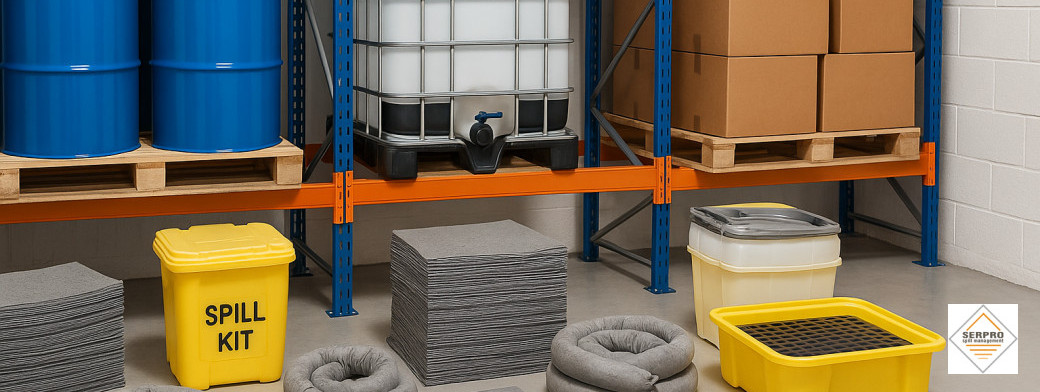
Make high-risk deliveries to a designated reception point with suitable surface protection and access to spill kits. The kit must match the liquids actually received: oil-only absorbents can help with known hydrocarbon leaks, but do not automatically suit aqueous chemicals.
Use containment that fits the storage
Where appropriate, store compatible containers over correctly sized bunds or drip trays with enough capacity for the assessed release. Check load ratings and forklift clearance. Keep incompatible substances segregated and do not allow an apparently empty bund to become a general storage shelf.
Identify the surface-water drains and routes a release could take. Drain covers can form one part of an emergency response, but drainage isolation must be safe, authorised and planned in advance. The Environment Agency’s guidance for businesses (England) covers storage, loading and inspection duties.
After a damaged delivery
Photograph and quarantine the load only when safe to do so, record the consignment details, and involve the supplier or carrier. A damaged pallet is a stock-control problem as well as a potential environmental incident; reopening the aisle without fixing the cause invites a repeat.
