
Published: 26 September 2026
Last updated: 24 August 2026
Why is Spill Planning Essential in Palletised Liquid Storage?
Spill planning is essential in palletised liquid storage because even a small leak from a drum, IBC or liquid carton can spread quickly across a warehouse floor, enter drains, damage stock, create slip hazards and expose staff to harmful substances. Palletised liquid storage means storing liquids in containers such as drums, intermediate bulk containers and boxed units on pallets so they can be moved, stacked and handled by forklift or pallet truck. Typical contents include oils, fuels, paints, inks, cleaning chemicals, detergents, food ingredients and other process liquids. In practice, safe storage relies on a combination of inspection, secondary containment, clear segregation, and nearby spill-control measures such as drip trays, absorbent pads, absorbent socks, spill kits and drain protection, alongside UK duties to prevent pollution and control exposure risks.
In other words, spill planning matters because palletised storage concentrates large volumes of liquid in busy handling areas where container damage, poor stacking, punctures and slow weeping leaks can go unnoticed until they become a bigger incident. A planned response helps staff spot early warning signs, isolate the problem, use the right absorbents for oil, general liquids or chemicals, and deal with waste safely. It also supports good housekeeping and aligns with UK guidance on pollution prevention for businesses and the HSE’s COSHH approach to controlling hazardous substances.
Why planning matters in day-to-day storage areas
Palletised liquid storage is common in warehouses, factories, workshops and distribution sites because it makes bulk handling efficient, but it also means one damaged container can affect a wider area very quickly. Forklift contact, split shrink wrap, unstable loads, failed taps, degraded seals and overfilled containers are all common starting points for spills. Without a plan, staff may not know who should respond, what materials to use, or how to stop liquid reaching walkways and drains.
A practical spill plan improves response times and reduces consequences. It should link storage layout, inspection routines and equipment placement, with suitable containment and clean-up materials kept close to likely risk points. This is why businesses often combine sound storage practice with liquid storage solutions and a wider spill preparedness approach, so minor leaks can be managed before they become injuries, pollution events or costly stock losses.
What Types of Liquids are Commonly Stored in Palletised Containers?
Palletised containers commonly hold a wide range of liquids, including chemicals, oils, fuels, cleaning products, paints, inks, food ingredients and drinks. Each category brings different failure risks if a drum, IBC or carton becomes damaged: some liquids create slip hazards, some can pollute drains and ground, some may react dangerously with other substances, and others can spoil stock or contaminate food areas. In practice, the type of liquid stored should shape how containers are checked, segregated and supported by secondary containment.
Chemicals are one of the highest-risk categories because they may be corrosive, toxic, flammable or reactive. Sites storing acids, alkalis, detergents, solvents or process chemicals should follow suitable controls under COSHH and use storage arrangements appropriate to the substance, including segregation and bunding where needed. For higher-risk stock, dedicated chemical storage measures are often necessary to reduce the consequences of leaks from palletised units.
Oils and lubricants are also widely stored on pallets, especially in warehouses, workshops and distribution settings. Hydraulic oil, engine oil and other petroleum-based liquids may seem less aggressive than chemicals, but they spread quickly, make floors dangerously slippery and can cause serious environmental harm if they reach surface water or drains. Where these products are present, robust oil storage controls and nearby spill response materials are important.
Food products such as edible oils, sauces, syrups, dairy ingredients and beverages are another common category. Although they may appear lower risk, leaks can still create hygiene problems, attract pests, damage packaging and generate severe slip hazards. In mixed-use facilities, food liquids should also be protected from contamination by non-food substances.
Regulatory considerations vary by product, but UK sites should assess storage risks, prevent pollution and maintain safe housekeeping. That includes checking labels, safety data information, compatibility, drain protection and inspection routines, rather than treating all palletised liquids as if they present the same hazard.
Where Do Spills Typically Start in Warehouses?
Spills in warehouses usually start at predictable weak points: damaged drums or IBCs, poorly sealed taps and valves, overfilled containers, punctured cartons, and small leaks that go unnoticed on pallets or in racking. In practice, most incidents begin as minor drips, weeping seams or transfer errors rather than sudden container failure. That is why regular spill inspections matter: they help teams spot early warning signs before liquid reaches walkways, stock or drains.
During checks, focus on both the container and its surroundings. A stained pallet, damp shrink wrap, residue around bungs, corrosion on metal drums, bulging sides on plastic containers, or a persistent odour can all point to a developing leak. Even a small release can create slip risks, especially on smooth warehouse floors, so it is worth aligning inspections with wider warehouse safety routines and HSE advice on slips and trips.
Common spill scenarios to look for
- Slow leaks: weeping seams, cracked lids, loose caps, worn valve seals and damaged taps on drums or IBCs.
- Overfills: containers filled beyond safe capacity, especially after decanting or returns handling.
- Impact damage: fork truck strikes, pallet collapse, crushed corners and punctures during movement or stacking.
- Poor secondary containment: full, cracked or badly positioned drip trays and bunded areas that cannot capture a release.
Areas of concern in a warehouse environment
Pay particular attention to goods-in areas, decanting points, battery charging zones, picking aisles, racking uprights, loading bays and any location near surface water drains. High-traffic routes are more likely to suffer impact damage, while low-visibility corners can allow small leaks to build up unnoticed. Mixed storage can also increase risk if incompatible liquids are kept too close together.
Regular inspections help staff catch these issues early and make sure absorbent pads, absorbent socks, drip trays, drain covers, gloves and disposal bags are available where they are most likely to be needed. A consistent inspection routine turns spill response from a reactive task into part of normal housekeeping.
What Should Be Kept Nearby to Manage Potential Spills?
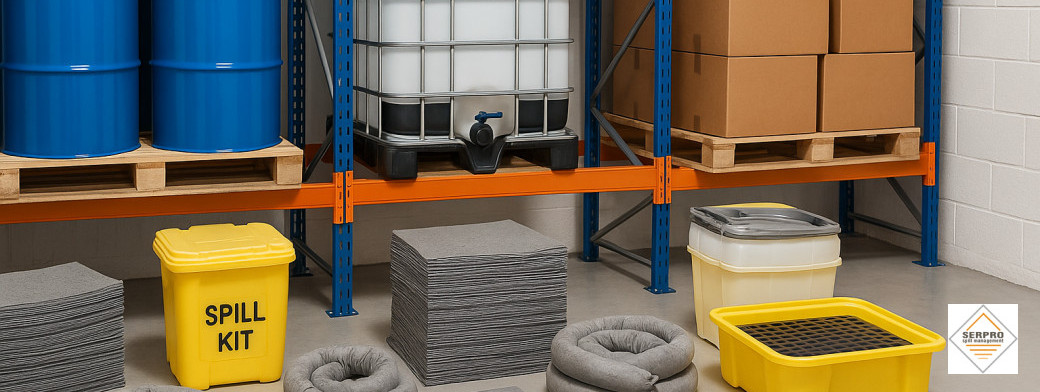
Keep a clearly marked spill response setup close to palletised liquid storage so staff can act immediately if a drum, IBC or carton starts to leak. The aim is simple: contain the liquid quickly, protect drains and walkways, and stop a minor weep becoming a larger clean-up or slip hazard. Equipment should match the liquids on site and be easy to see, easy to reach and checked as part of routine warehouse inspections.
For most storage areas, that means having suitable spill kits, the right absorbents, temporary containment items and basic PPE nearby rather than stored in a distant cupboard. In UK workplaces, fast access supports good housekeeping, helps reduce slips, and fits with wider pollution prevention and COSHH control measures where hazardous substances are involved.
Recommended spill response products
- Small or medium spill kits positioned near racking, loading areas and decanting points
- Absorbent pads and rolls for drips, splashes and floor contamination
- Absorbent socks to contain spreading liquid around pallets or along aisle edges
- Drip trays for suspect containers, taps, couplings or damaged lower corners
- Oil-only, general purpose or chemical absorbents selected to suit the stored liquid
- Drain covers or drain protection where a spill could reach surface water or foul drains
- Disposal bags and ties for used absorbents and contaminated debris
- Gloves and other task-appropriate PPE for the first response
Why accessibility and visibility matter
Spill equipment is most useful when it is obvious and immediately accessible. Keep kits at ground level, close to likely leak points, with clear signage or spill station labelling so staff do not lose time searching. Avoid blocking kits behind pallets, cages or wrapping materials. If liquids are stored across several bays, it is usually better to place multiple smaller response points than rely on one central kit.
Best practice for spill kit management
Check kits regularly, restock used items straight away and make sure contents still match the liquids currently stored in that area. Include spill stations in housekeeping and inspection routines, confirm staff know who should respond, and separate used absorbents for safe disposal according to the substance involved. A spill kit does not make a site compliant by itself, but a visible, maintained and well-matched response setup makes early intervention far more practical.
Who Should Respond to a Spill Incident?
The right people to respond to a spill incident are those who have been clearly nominated, trained and equipped for the liquids stored on site. In a palletised storage area, that usually means the first person on scene making the area safe, a trained spill responder or supervisor assessing the risk, and a manager or health and safety lead overseeing escalation, reporting and clean-up arrangements. Not every member of staff should attempt full spill response, especially where chemicals, mixed liquids or unknown leaks are involved.
Roles should be defined before an incident happens. Warehouse operatives may isolate the area, stop traffic, raise the alarm and use nearby absorbents for a very minor, low-risk leak if they have been instructed to do so. Trained responders should then take over where containment, drain protection, PPE selection or waste segregation is needed. Supervisors should decide whether the incident can be managed in-house or whether external help is required, while managers should ensure follow-up through incident reporting, stock checks and corrective actions.
Training is what makes this workable in practice. Staff need to know the difference between oil, general purpose and chemical absorbents, where spill kits, drain covers, gloves and disposal bags are kept, and when a leak from a drum, IBC or carton is beyond their competence. Regular spill response training helps teams act quickly without improvising.
Clear communication is equally important. Emergency contacts, spill station labels and simple reporting lines reduce delay and confusion. During the incident, staff should communicate what has leaked, where it is moving, whether drains are at risk and who is in charge. Afterward, the same clarity supports investigation, replenishment of used materials and safer storage checks going forward.
How Should Waste from Spills Be Separated and Handled?
Waste from palletised liquid spills should be separated by both what has been spilled and what has been used to clean it up. In practice, that means keeping contaminated absorbents, damaged packaging, leaked product and any wash-down residues apart where possible, then storing them in clearly labelled containers for safe collection. This helps prevent cross-contamination, supports safer handling, and makes it easier to decide whether the waste is general, specialist or hazardous.
For warehouses and storage areas, the safest approach is to treat spill waste as potentially harmful until it has been identified. Staff should check the product label and safety data sheet, follow site procedures, and apply the control measures required under COSHH guidance from HSE. Good segregation, prompt reporting and accurate records are all important if a spill involves oils, chemicals, solvents, cleaning liquids or other substances that could affect people, drains or the wider environment.
Best practice for separating spill waste
Use separate, clearly marked containers or bags for different waste streams. For example, keep oil-contaminated pads and socks apart from chemical absorbents, and do not mix clean packaging with saturated materials. Damaged drums, IBC components, shrink wrap, pallets and outer cartons may also need separating if only some items are contaminated. If drain protection, drip trays or spill kits have been used, inspect them carefully and isolate anything that cannot be safely reused.
Where the spilled liquid is unknown, or where mixed contamination is possible, err on the side of caution and isolate the waste until a competent person can assess it. This reduces the risk of incompatible materials being stored together and supports safer onward collection through a suitable waste management service.
Legal requirements for hazardous waste disposal
If the spilled substance or contaminated cleanup materials are classed as hazardous, they must be handled and disposed of in line with UK legal requirements. That can include correct classification, secure containment, labelling, storage and transfer to an authorised waste carrier or disposal provider. Businesses should not assume that used absorbents or damaged containers can go into general waste simply because the spill was small. Where hazardous materials are involved, specialist support such as hazardous waste disposal may be needed.
Why documentation and reporting matter
Every spill should be recorded with enough detail to show what happened, what substance was involved, what waste was produced, and how it was contained and removed. Keep internal incident reports, waste transfer notes and any hazardous waste paperwork together. Good documentation helps demonstrate due diligence, supports follow-up checks on damaged containers, and can reveal repeat issues in storage, handling or housekeeping before a larger failure occurs.
How Can Routine Inspections Ensure Safe Liquid Storage?
Routine inspections help ensure safe liquid storage by finding small defects before they turn into leaks, unstable loads or wider spill incidents. For palletised drums, cartons and IBCs, regular checks make it easier to spot early warning signs such as weeping seams, dented cages, damaged valves, stained pallets or missing labels. They also confirm that secondary containment, spill response materials and housekeeping standards are still suitable for the liquids being stored.
In practice, inspections should be simple, consistent and recorded. A brief daily visual check can catch obvious issues on the warehouse floor, while more detailed scheduled reviews help teams assess container condition, segregation and readiness to respond. Using clear inspection checklists also supports follow-up actions, so damaged stock is isolated promptly rather than left in service.
What should be checked during routine inspections?
- Container condition: look for bulging, dents, cracks, punctures, corrosion, split seams or damaged closures.
- IBC frames and pallets: check cages for distortion, broken welds, loose bases and poor pallet integrity.
- Valves, taps and bungs: inspect for drips, residue build-up, loose fittings or signs of previous overtightening.
- Leaks and contamination: note staining, wet patches, odours, pooled liquid or absorbents already in use.
- Labels and identification: confirm contents, hazard information and handling instructions remain legible.
- Storage set-up: make sure loads are stable, segregated appropriately and supported by suitable liquid storage solutions such as bunds or drip trays where needed.
- Spill readiness: verify that pads, socks, drain protection, disposal bags and gloves are nearby and easy to access.
Common signs of wear include rubbed corners, stress marks around handles, warped plastic, rusting metal chimes and repeated residue around outlets. Even minor damage matters if it suggests the container has been struck, overstacked or exposed to incompatible conditions.
Documentation is just as important as the physical check. Inspection records show trends, support incident reporting and help prove that defects were reviewed and acted on. If damage is found, the next steps should be clear: quarantine the container, clean any escaped liquid safely, replace compromised packaging, review the cause and confirm that corrective actions have been completed.
What Are the Consequences of Failing to Manage Liquid Storage Properly?
Failing to manage palletised liquid storage properly can lead to far more than a messy clean-up. In warehouses and yards, damaged drums, IBCs or cartons can leak oils, chemicals or other process liquids onto floors, into drainage systems or into the surrounding ground. That creates immediate safety risks, but it can also trigger environmental harm, disruption to operations, enforcement action and significant cost. In practice, poor storage management often turns a small, containable leak into a wider incident.
One of the most serious consequences is environmental damage. Even a relatively small spill can contaminate surface water, soil or drains if it is not contained quickly with suitable measures such as drip trays, absorbents and drain protection. Businesses are expected to plan for these risks, not simply react after a release has happened, which is why spill preparedness and clear inspection routines matter.
There are also legal and financial repercussions. If a business stores liquids badly, ignores damaged containers or fails to control leaks, it may face clean-up costs, lost stock, damaged goods, downtime, higher waste disposal charges and possible claims if employees or third parties are affected. Depending on the substance and the incident, regulators may investigate whether the site had suitable controls, training and containment in place. UK guidance on pollution prevention and workplace safety makes it clear that storage, housekeeping and response arrangements must be proportionate to the risks.
Compliance is therefore not a paperwork exercise; it is part of practical risk control. Sites handling palletised liquids should align their checks with wider compliance duties, including safe storage, spill response, waste segregation and reporting. Regular inspections, prompt isolation of damaged containers and documented corrective action help reduce the chance of environmental incidents, injuries and avoidable enforcement problems.