
Last reviewed: 13 November 2026
Solvents are part of many conservation treatments, but a leak in a museum laboratory carries two kinds of risk. Staff may be exposed to flammable or harmful vapours, while spilled liquid or contaminated absorbent can permanently damage an artefact, its packaging or the work surface. The response must protect both people and the collection; a general workshop procedure is not sufficient.
Prevent problems at the treatment bench
Use the smallest practicable working quantity and keep original containers sealed when not in use. Choose stable, compatible bottles and secondary containers; avoid leaving open solvents beside heaters or unsuitable electrical equipment. Assess extraction, ventilation and ignition control under HSE COSHH guidance and HSE DSEAR guidance where applicable.
Arrange bench layout so bottles cannot be knocked over during object handling. Keep collection objects outside the likely spill path, and use compatible drip trays where these are appropriate to the process and material. Never assume a tray or liner is safe next to a historic object without conservation approval.
Respond without putting collections at greater risk
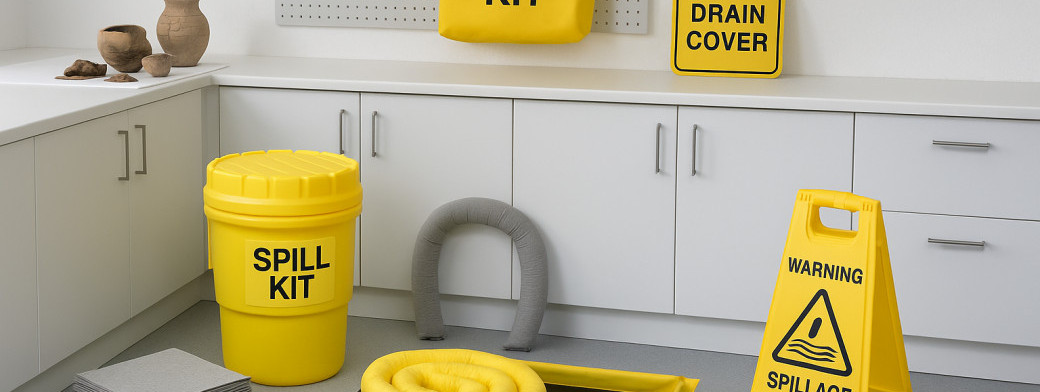
For a known, small spill, trained staff may follow an approved solvent-specific procedure using suitable protective equipment and compatible chemical absorbents. Many absorbents are designed for industrial floors and may shed fibres, stain surfaces or react with particular solvents. They must not be applied directly to an artefact without the conservator’s direction.
If there is strong vapour, an ignition risk, a large release or an unidentified mixture, stop work, keep others out and implement the laboratory emergency procedure. Do not casually wash solvents into the drain or transfer saturated material to an unlabelled bin.
Plan for the aftermath
- Keep an up-to-date inventory and safety data sheets.
- Identify who can authorise handling of affected collections.
- Specify compatible spill materials for each solvent group.
- Segregate contaminated waste and arrange lawful disposal.
- Review near misses when treatment activities or solvents change.
The governing assessment must account for the treatment method, the conservation environment and the solvent involved. General spill kits can be useful for site maintenance, but it is not a substitute for a conservation laboratory response protocol.