
Last reviewed: 13 November 2026
In a busy warehouse, a leaking pallet can create two problems at once: nobody knows exactly what is escaping, and forklifts and pedestrians are still moving around it. The first decision should therefore be how to make the area safe, not which absorbent pad to grab.
Start at goods-in and returns
Split bottles, punctured IBCs, damaged cartons and unstable mixed pallets are common sources of leaked liquids. In returns handling, product labels may be missing or several damaged packages may have contaminated each other. Don't treat an unidentified mixture as an ordinary general purpose spill.
Assess the risks around vehicle routes, pedestrian crossings, conveyors and loading bays. A liquid can move a long way across a smooth floor or travel outside via a yard drain. Keep staff clear and suspend traffic through the affected zone while its contents are identified.
Choose equipment for the known hazard
Where a liquid is identified and the work is within a trained responder's remit, general purpose absorbents may suit some water-based releases. Oil-only materials suit many hydrocarbons but not all mixed cargo. Chemical absorbents require compatibility checks; they do not make unknown reactions safe.
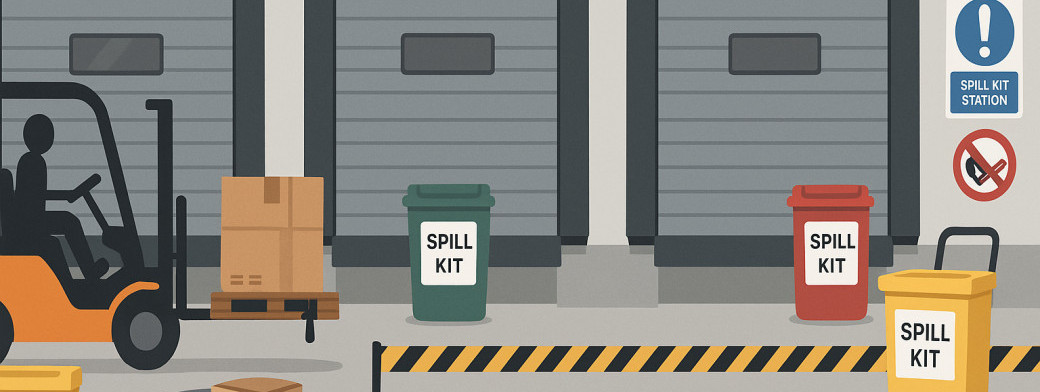
Place spill kits near goods-in, returns and significant liquid storage, but outside likely spill paths. Kit contents should follow the site's product categories and risk assessment. For storage, suitable drip trays or secondary containment may prevent routine leaks; bulk or high-consequence storage needs a more robust design.
Think about traffic and drainage
A forklift can track contamination from one aisle to another, and emergency access must remain clear. Use appropriate barriers, suspend vehicle movements and agree safe pedestrian diversions. Trained responders may deploy drain covers at suitable gullies if conditions allow; a blocked drain should not create a new flood or other hazard.
Inspect high-risk areas regularly, especially after deliveries and at shift handovers. Damaged packaging should be isolated in a suitable, compatible overpack or containment arrangement, rather than moved through the warehouse while still leaking.
Set clear limits on first response
- Report the leak and make the surrounding area safe.
- Identify the product from packaging, records and safety information if this can be done without approaching a dangerous release.
- Escalate unknown, reacting, flammable or otherwise hazardous spills to the appropriate specialist team.
- For a safe, manageable release, contain and recover it with authorised compatible materials.
- Classify, label and store contaminated waste, then inspect and reopen the area.
Include agency staff and goods-in teams in induction, even when they are not authorised to clean chemical spills. They need to recognise damaged loads, know how to stop traffic safely and understand whom to call.
Learn from repeated pallet leaks
Record the supplier, product, packaging failure, location and clean-up route. Recurrent damage may call for changes to pallet wrapping, storage positions, fork handling or receiving checks. A spill log is most useful when it leads to fewer incidents, not simply more paperwork.