
Last reviewed: 13 November 2026
In pharmaceutical manufacturing, a liquid spill may threaten operator safety, equipment, product integrity or the classified status of a production area. Cleanroom incidents call for more than simply placing pads on the floor: the site must also consider particles, residues, validation and the quality implications of any intervention.
Separate cleanroom incidents from general housekeeping
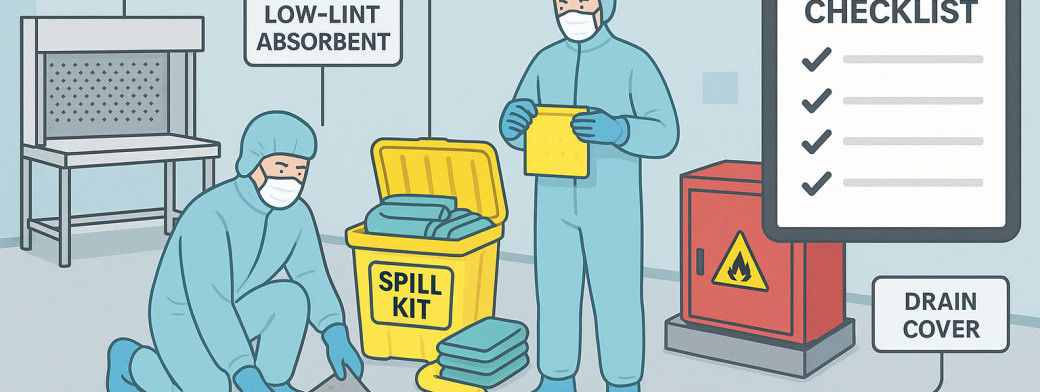
Sterile manufacturing areas are controlled environments. Ordinary warehouse absorbents can shed fibres or introduce particles, and must not be described as cleanroom-safe unless suitability has been demonstrated for the actual area and use. Use site-approved, qualified materials and follow the relevant contamination-control and cleaning procedures.
A spill affecting exposed product, equipment or a controlled surface may trigger batch assessment, deviation reporting and QA approval before production restarts. Do not return an area to use simply because the visible liquid has gone.
Control chemical and utility leaks at source
Alcohols, solvents, cleaning agents and process fluids each create different fire, exposure and compatibility risks. Identify the material from the process documentation and safety data sheet. Isolate equipment where safe, restrict access and use the site's trained-response procedure for significant or uncertain releases.
Outside the classified area, bunded chemical storage, correctly selected drip trays and compatible chemical absorbents may reduce routine maintenance and transfer spills. These products should not be carried into a cleanroom without the site’s approval.
Record what happened and what it affected
Record the affected room, batch or equipment, liquid, likely source, duration, containment action, cleaning method and any environmental monitoring required. Quality assurance, engineering and environmental teams may each need to sign off different parts of the recovery.
Inspection routines should include hoses, dosing lines, IBC connections, drains and maintenance access routes. If a drip persists, repair the fault: routinely replacing saturated pads is not an adequate long-term control.
Practical next steps
For non-classified stores and utilities, review SERPRO spill kits and secondary containment against your own assessments. For classified production areas, the approved GMP contamination-control strategy takes precedence.
