
Last reviewed: 13 November 2026
A small dye leak may only stain a workshop floor, but a large discharge of dye liquor, solvent or finishing chemical can disrupt treatment processes and pollute water. Textile mills and dye houses therefore need spill arrangements tailored to their chemical inventory, process tanks and effluent systems.
Map liquids along the production line
Consider colourants, concentrated dyes, wetting agents, bleaches, acids, alkalis, finishing formulations and cleaning chemicals. Their hazards vary considerably. The fact that a liquid is diluted or coloured does not mean it is harmless or suitable for a general purpose absorbent.
Check safety data sheets and COSHH assessments. Unidentified solutions, strong oxidisers and substances that might react with other process chemicals need isolation and specialist assessment rather than improvised neutralisation.
Focus on dosing, mixing and transfer points
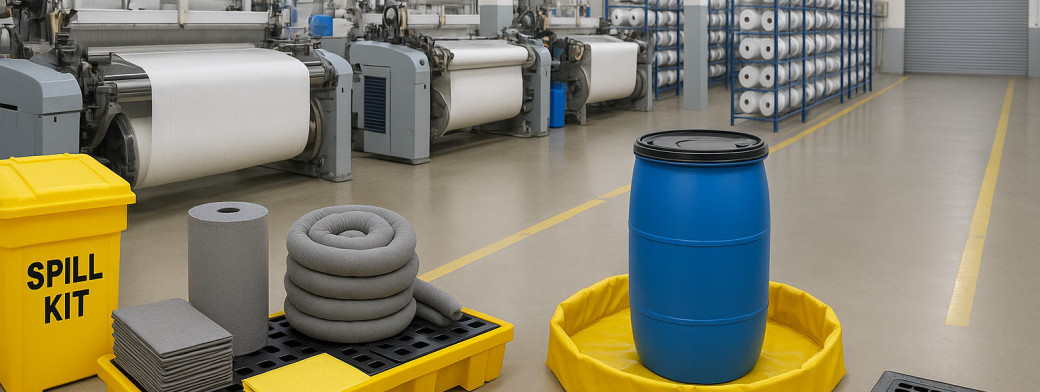
Inspect drums, transfer pumps, flexible hoses, IBC valves, dosing equipment and tanks. Provide secondary containment compatible with stored chemicals and keep incompatible streams separate. A drip tray can be useful beneath a local dispensing point, but large tank losses require larger engineered controls.
Position suitable chemical absorbents and spill kits where trained staff can access them for manageable incidents. Match products to the actual formulation, not merely to the colour of the absorbent.
Keep contaminated process liquid out of the wrong drain
Identify whether floor drains lead to process-water treatment, a consented trade effluent system or surface water. Do not assume that any drain can accept a dye or chemical release. Large spills should be recovered and handled through the approved site waste-water arrangements.
Where appropriate, drain covers may support short-term protection of suitable gullies. Their use must not cause uncontrolled flooding or allow incompatible chemicals to mix elsewhere.
Training and waste management
- Train staff to stop the transfer safely and identify the substance before clean-up.
- Keep a current chemical inventory and emergency contact list near the process area.
- Segregate used absorbents and contaminated packaging according to waste classification.
- Inspect bunds, pipework and spill kits after any incident or process change.
- Record recurring leaks and use the findings to improve equipment maintenance.
Refer to HSE COSHH guidance and the site’s environmental permits or discharge consents. For textile businesses, stopping loss at source is usually more effective than relying on clean-up after a tank empties.
