
Last reviewed: 13 November 2026
Defence-related sites range from vehicle workshops and maintenance depots to airfields, dockyards and specialist manufacturing facilities. Their spill risks are not identical. What they share is the need to control liquids without compromising personnel safety, operational access or the local environment.
Start with the operational area
Fuel handling, hydraulic systems, oils, cleaning solvents, paints and specialist process chemicals may all be present. The highest-risk points often include servicing bays, bulk storage, transfer hoses, vehicle movement areas and external hardstanding with nearby drainage. Identify the actual substances, their quantities and the route an accidental release could follow.
Security arrangements can affect spill response. If equipment is inside a restricted store, the nominated responders must still be able to reach it promptly. Plan for shifts, contractors and temporary operations. Follow the site's established defence and environmental procedures rather than assuming that general commercial guidance covers every requirement.
Different hazards call for different absorbents
Oil-only absorbents may be appropriate for known hydrocarbon releases, including some outdoor situations. General purpose materials cover a range of compatible everyday liquids, while chemical absorbents are intended for particular chemicals. None is automatically suitable for an unidentified or reactive substance.
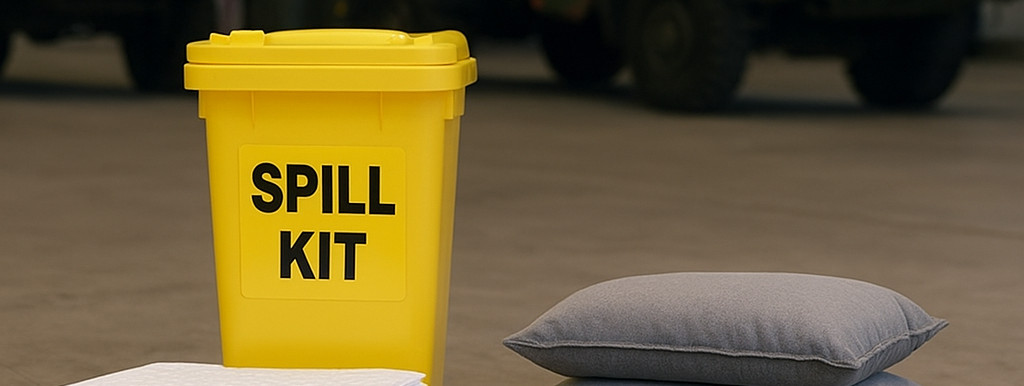
Match the spill kit contents to a realistic spill scenario and to the available trained response team. A small bagged kit in a service vehicle has a different purpose from containment beside a fixed bulk-liquid store. For high-consequence releases, improve storage design and specialist response arrangements rather than relying on more absorbent pads.
Containment before clean-up
Maintained hoses, secure storage and protection against vehicle impact prevent many foreseeable incidents. Place suitable drip trays at repeated service leak points; use correctly designed secondary containment for bulk drums and tanks when required. Keep incompatible substances segregated.
External drains, ditches and watercourses may be particularly sensitive. Map them in advance and provide suitable drain covers or other barriers where their safe deployment is realistic. A drain cover is one measure, not a substitute for an incident plan.
Set a safe boundary for first responders
Staff should know how to report a leak, protect access routes, identify the material and isolate the source if safe. They should also know when to withdraw. Significant fuel releases, unknown chemicals, strong fumes or other dangerous conditions require competent specialist response in accordance with the site's procedures. Never treat PPE in a generic kit as permission to approach every hazard.
Used absorbents, contaminated soil and recovered liquids need classification and approved disposal routes. Keep incident records sufficient to explain the source, containment, effect on drains and corrective work. Requirements may involve site-specific permits or contracts in addition to general UK duties.
Check readiness without disrupting operations
Inspection routines should include kit contents, accessibility, signage, drain-control equipment and the people authorised to respond. Following an incident or exercise, review whether the equipment was suitable and whether access arrangements caused delay. The useful measure is not the number of kits purchased, but whether the intended control works when needed.