
Last reviewed: 13 November 2026
Businesses often ask which UK regulation says they must keep a spill kit or use a bunded pallet. There is no single rule that covers every spill and every workplace. The answer depends on what is stored, where the premises are located, the type of activity and the risk to people and the environment.
That distinction is useful. A workshop with a few lubricating-oil drums has different requirements from a large fuel depot or a chemical-processing site. Good compliance begins with identifying the rules that actually apply, then selecting appropriate controls.
Start with the four UK jurisdictions
Environmental regulation is not identical across the UK. England, Wales, Scotland and Northern Ireland have their own regulators and, in some cases, different oil-storage rules and supporting guidance. The Environment Agency's pollution-prevention guidance is a useful starting point for businesses in England; it should not be presented as a single legal checklist for every UK site.
Before quoting a containment capacity or reporting requirement, establish the site's location and consult the relevant regulator or competent adviser. Industry guidance helps interpret good practice, but guidance itself is not automatically legislation.
Oil storage and secondary containment
For businesses in England, the official oil-storage guidance explains when the oil-storage regulations apply and what secondary containment is required. In relevant cases, individual fixed tanks and IBCs need capacity equivalent to at least 110% of the container; different calculations apply to drum stores and multiple containers. Using “110% for everything” can therefore be misleading.
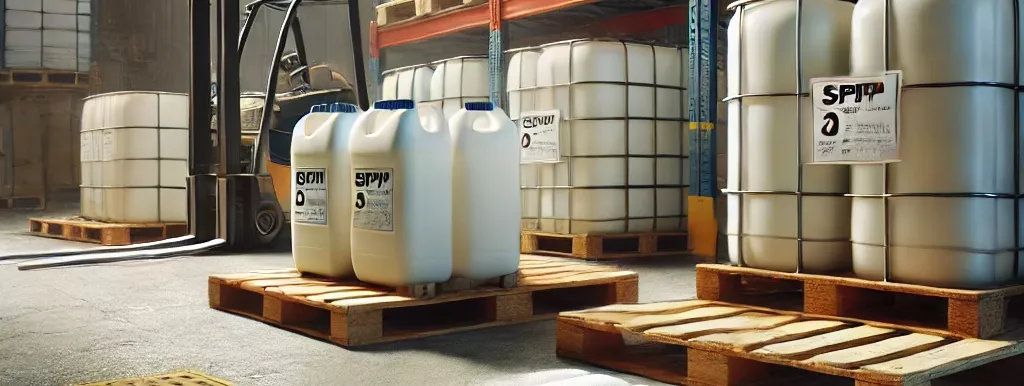
Secondary containment means an additional barrier intended to hold liquid if the primary tank, drum or container leaks. A properly specified bund or spill pallet may provide this protection. A small drip tray is useful for minor service drips but is not automatically a compliant bund for bulk storage.
Check liquid compatibility, containment volume, loading capacity, accessibility, and whether rainwater or other stored goods could reduce usable capacity. A bund is only effective if it is kept sound and any accumulated liquid is removed safely.
Hazardous substances and workplace safety
The Control of Substances Hazardous to Health (COSHH) framework requires relevant risks from hazardous substances to be assessed and controlled. This includes planning for foreseeable accidents and spillages. Employers also have wider duties to protect people from slipping, fire and other workplace hazards.
These requirements do not mean every cleaner, solvent or laboratory reagent can be dealt with using the same kit. Incompatible chemicals, flammable vapours and unknown liquids may require isolation and a specialist response. Staff should be trained for the incidents they are authorised to handle.
Polluted run-off, drains and permits
Not all drains lead to a treatment works. A surface-water gully may discharge to the environment, so a spill on a yard can become a pollution incident very quickly. Site plans should identify drainage routes and any arrangements for interceptors, isolation valves or authorised trade-effluent discharge.
Drain covers can be part of an emergency response where their fit and material are suitable and staff can deploy them safely. They do not replace prevention or automatically authorise a discharge. Some activities also require an environmental permit or a separate water-company consent.
Waste is a separate compliance decision
After clean-up, pads, socks, recovered liquid and contaminated debris must be assessed as waste. In England, the Environment Agency's waste-classification guidance explains the responsibility to identify and classify material before collection. An absorbent does not become non-hazardous simply because the liquid has been soaked up.
What a proportionate spill-control arrangement looks like
Start with an inventory of stored liquids and the routes they could take if released. Inspect containers and transfer systems, provide appropriate secondary containment, and locate compatible spill kits near foreseeable manageable spills. Record who may respond, when work must stop and how waste will be handled.
The most reliable way to meet your obligations is to treat spill control as a site-specific risk assessment, not as a standard shopping list. Check the applicable national rules whenever storage, products or operations change.